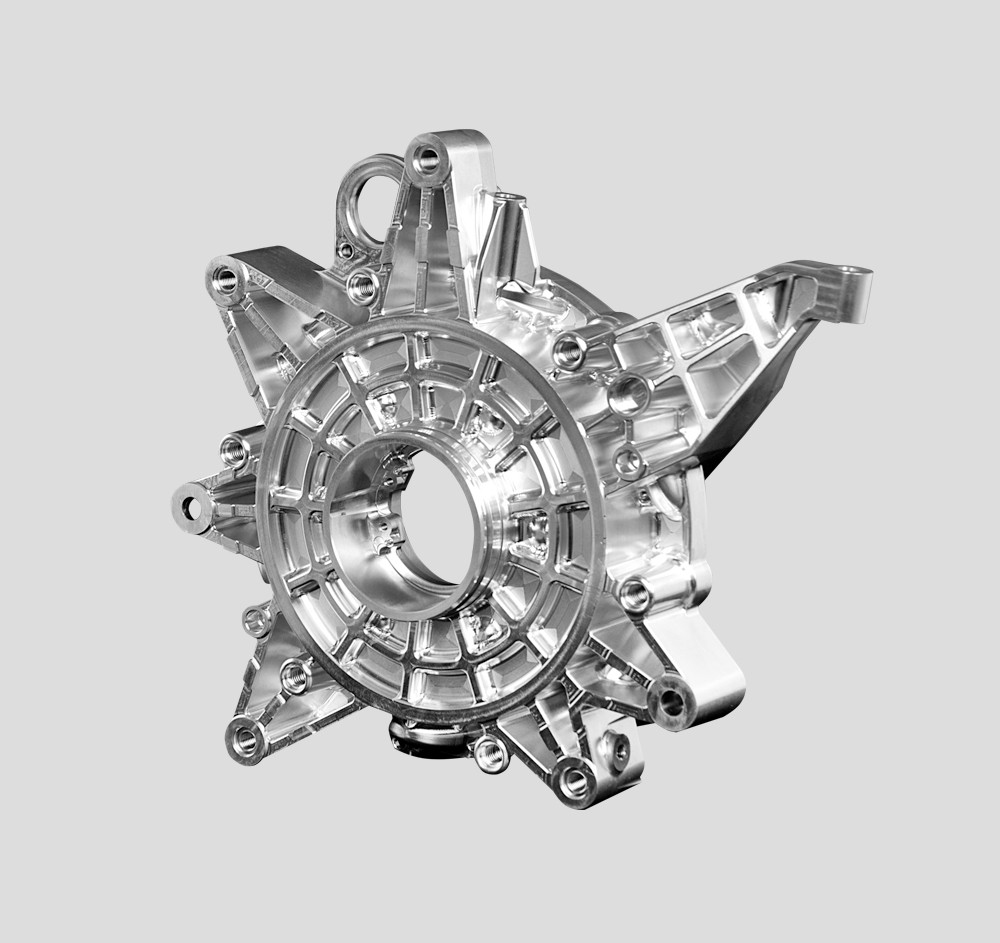
CNC machining services for functional prototypes and low-volume production parts, machined to ±0.025 mm in metals and engineering plastics.
About CNC Machining
Protom is equipped to produce machined parts for prototyping and low volume manufacturing. High precision components can be machined in metals like steel, stainless steel, aluminium, brass and copper, and in engineering plastics such as Nylon (PA), ABS, PC, POM (Delrin), PEEK, PEI (ULTEM) and PTFE. Metal and high performance plastics are often machined to make end-use parts in small quantities, where the geometry is too demanding or the volume too low for moulding.
Machining is frequently more cost effective than other technologies for low volume requirements, because there is no tooling to amortise. A 5-axis machine can turn a billet into a finished part in days, and design changes between iterations cost nothing beyond the machining time.
Machining capacity
Protom runs more than 200 high precision machining centres, including 20+ DMG MORI (Deckel Maho) 5-axis machining centres, 3- and 4-axis vertical and horizontal mills, CNC lathes with live tooling, and EDM for hard internal corners and deep ribs. That mix allows a tight tolerance on a sealing bore and an uninterrupted curve to be produced in the same setup.
Typical results are ±0.025 mm (±0.001 in) on critical features and ±0.05 mm on general dimensions, with as-machined surfaces between 0.4 and 1.6 µm Ra. Bead blasting, anodising, powder coating, zinc plating and polishing are available as secondary operations.
Why engineers choose CNC machining
Precision. Tolerances as tight as ±0.001 in (0.025 mm), held on features that other processes cannot reach.
Repeatability. A programmed toolpath produces the same part on every run, which makes machining a practical bridge to mass production.
Complex geometry. Undercuts, deep pockets, thin ribs and organic surfaces can be cut without a mould.
Material choice. The full range of engineering metals and plastics is available in the exact grade the design calls for, rather than a mouldable substitute.
Speed. First parts in days, with unlimited design changes between iterations.
Designing a part for the machine
A component designed for the process costs materially less to make. Keep the part machinable from a single orientation where possible, because every extra setup adds a datum transfer and its own tolerance stack. Give internal corners a radius of at least one third of the pocket depth rather than asking for a square corner that no cutter can produce. Watch the depth-to-diameter ratio on bores and pockets: past roughly 4:1 a slender tool deflects, so either widen the tolerance or step down in stages. Add a floor fillet instead of a sharp internal corner to remove a stress riser and allow a stiffer cutter to sweep the pocket. Plan how the part will be held — thin walls, tall fins and long unsupported spans move when the vise is released, so a small boss or a sacrificial tab often removes the need for a custom fixture. Finally, avoid applying one surface finish across the whole part; call out a finish only on the faces that seal, slide or are seen.
CNC machining compared with the alternatives
Below roughly 500 parts the tooling cost of die casting or plastic injection moulding has not yet been recovered, and machining is usually both faster and cheaper. 3D printing wins when the geometry is impossible to cut or the deadline is measured in days. Once a design is proven and volumes climb into the thousands, die casting and injection moulding take over at a much lower piece price. Because Protom runs all of these processes in house, the route is chosen on cost and lead time rather than on what a single supplier happens to own.
Applications
High-precision automotive parts, aerospace brackets and housings, medical instrument components, robotics and drone frames, and electronics enclosures — generally where a part has to survive a functional test rather than simply look right.
Metal machining and plastic parts under one roof
Protom's metal machining capacity covers aluminium, stainless steel, brass, copper and tool steel, while a parallel plastics cell handles POM, PC, ABS, Nylon and PEEK. A single enquiry can therefore be quoted as a machined prototype, a 3D printed check part, a vacuum cast bridge batch, or a full plastic injection molding tool — whichever route gets the product to market fastest at the volume you actually need.